The valve may be the most visible part of a tube amplifier, but its character is shaped by much more: transformers, circuit architecture, operating conditions and the loudspeaker connected at the other end.
Tube amplification has a recognisable visual language. Glass valves glow above the chassis, transformers occupy substantial space, and the circuitry often feels more physically present than in many contemporary electronics. It is natural, then, to assume that the valves themselves determine what we hear.
They matter considerably, but they are only one part of the design. Two amplifiers can use the same output tube and present music quite differently. The reason lies in everything surrounding it: how the tube is biased, the topology in which it operates, the output transformer, power supply, feedback arrangement and the loudspeaker it is ultimately asked to drive.
There is therefore no single formula for how a tube amplifier should sound. That variety is part of the category’s appeal.
The Valve Is the Beginning
At its simplest, an amplifier takes a small electrical signal and increases it sufficiently to drive a loudspeaker. A vacuum tube controls the flow of electrons within a sealed glass envelope, allowing a relatively small input signal to regulate a larger current.
Different valves are designed for different roles. Smaller tubes may handle input and driver stages, while larger output tubes such as the EL34, KT88, KT120 or KT170 deal with the power required by the loudspeaker.
Each family has its own electrical characteristics, but a tube type should not be thought of as a fixed sonic preset. A KT88 used within one amplifier may operate under entirely different conditions from a KT88 in another.
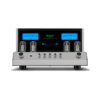
McIntosh, for example, currently uses four KT88 output tubes in its MA2375 integrated amplifier alongside its own Unity Coupled Circuit output-transformer design, producing 75 watts per channel. Jadis has its own transformer, bias, and circuit philosophies around the tube families it employs.
The valve gives the designer a set of possibilities. The complete amplifier determines how those possibilities are used.
Why the Transformer Matters
In many tube amplifiers, the output transformer is one of the most important components in the signal path.
Power tubes operate at electrical conditions quite different from those required by a loudspeaker. The transformer allows the two to work together while also influencing bandwidth, distortion, stability and the amplifier’s behaviour into different speaker loads.
This is why transformer design receives such attention from established tube manufacturers.
Jadis winds its transformers in-house in France and treats them as a defining part of its engineering. McIntosh has developed its own transformer-based approach through the Unity Coupled Circuit. The solutions are different because the design philosophies are different.
Neither approach exists simply to make an amplifier sound “more tubular.”
The objective is control: preserving the signal while allowing the output stage to work effectively with the loudspeaker.
Class A, Push-Pull and the Choices Behind the Sound
Terms such as Class A, Class AB, single-ended and push-pull often appear around tube amplification, but they describe different aspects of the circuit rather than grades of quality. Class A refers broadly to how continuously the output devices conduct through the signal cycle. It offers particular linearity advantages but operates inefficiently and produces considerable heat.
Push-pull describes an architecture in which complementary sides of the output stage share the work of reproducing the waveform. It can be implemented in Class A or Class AB depending on the designer’s chosen operating conditions.
Jadis, for example, uses pure Class A push-pull operation in several current amplifiers, including the I-70. These choices influence power, efficiency, distortion behaviour and ultimately the presentation of the amplifier, but none should be treated in isolation. Good engineering is about how the elements work together.
Harmonics and Tonal Character
Tube amplification is also frequently discussed in terms of harmonic distortion. Every amplifier introduces some degree of distortion. What matters is not simply the total figure, but how that distortion is distributed and how it changes as the amplifier approaches its operating limits.
This helps explain why two amplifiers with similar headline distortion measurements can still present music differently.
Circuit architecture, feedback and the way the output stage behaves under load all influence the final result.
For the listener, this may be perceived as differences in tonal density, texture, transient behaviour or the way instruments occupy space.
It is therefore more useful to listen for the amplifier’s overall character than to assume that one measurement—or one valve—is responsible for everything being heard.
The Loudspeaker Completes the System
No amplifier exists independently of the loudspeaker connected to it. A loudspeaker’s impedance changes across the frequency range, and its sensitivity, electrical phase behaviour, room placement and listening distance all affect how much is being asked of the amplifier.
This is why wattage alone rarely tells the full story.
A lower-powered tube amplifier paired thoughtfully with the right loudspeaker can operate with considerable ease. A more demanding loudspeaker may call for greater power reserves or a different output-transformer configuration. The question is not simply whether an amplifier produces enough watts.
It is whether the amplifier and loudspeaker allow one another to perform naturally within the room and at the listener’s preferred volume.
That relationship deserves its own discussion, which we will explore separately.
Different Houses, Different Interpretations
Perhaps the most interesting part of tube amplification is the variety it allows.
Two manufacturers may share valves, yet arrive at different results because their priorities lie elsewhere: transformer design, feedback, circuit simplicity, power delivery or the particular balance they seek between colour, clarity, control and dynamics.
Jadis and McIntosh are good examples. Both have decades of experience with valves and output transformers, yet their engineering approaches and visual identities are unmistakably their own.
That distinction is useful for the listener.
Choosing tube amplification is not simply a decision to pursue a predefined “tube sound.”
It is an opportunity to explore different interpretations of the same fundamental technology.
A Vocabulary of Its Own
The glow of a valve makes tube amplification easy to recognise. Its musical character is much harder and more interesting to reduce to a stereotype. The tube matters. So does the transformer.
The circuit determines how the tube operates. The power supply establishes the conditions around it. The loudspeaker completes the electrical relationship. And the designer decides how all of those elements should work together.
Tube amplification is therefore best understood not as one voice, but as a vocabulary from which different manufacturers create their own.
For the listener, that is where the pleasure begins.
Experience Tube Amplification at Dubai Audio
Dubai Audio represents tube amplification across several distinct design philosophies and system requirements. Our showrooms allow these differences to be heard within complete systems, where amplifier and loudspeaker can be considered together rather than through specifications alone.







(1).jpg)
(1).jpg)





